09 July 2010

Conversation; and First, How to Speak to God

"Physicians judge to a great extent as to the health or disease of a man by the state of his tongue, and our words are a true test of the state of our soul.  "By thy words thou shalt be justified, and by thy words thou shalt be condemned, "The Savior says.  We are apt to apply the hand quickly  to the place where we fell pain, and so too the tongue is quick to point out what we love. 

If you love God heartily, my child, yo will often speak of Him among your relations, household and familiar friends, and that because "the mouth of the righteous speaketh wisdom, and his tongue talketh of judgment."  Even as the bee touches naught save honey with his tongue, so should your lips be ever sweetened with your God, knowing nothing more pleasant than to praise and bless His Holy Name,--as we are told that when Saint Francis uttere the Name of the Lord, he seemed to feel the sweetness lingering on hislips, and could not let it go.  But always remember, when you speak of God, That He is spirit of meekness, love , and humility; dropping honey from your lips (like the Bride in the Canticles) in devout andpious wrods, as yo speak to one or another around, in your secret heart the while asking God to let this soft heavenly dew sink into their minds as they hearken.  And remember very especially always to fulfill this angelic task meekly and lovingly, not as though you were reproving others, but rather winning them.  It is wonderful how attractive a gentle, pleasant manner is, and how much it wins hearts.

Take care, then, never to speak of God, or those things which concern Him, in a merely formal, conventional manner; but with earnestness and devotion, avoiding the affected way in which some professedly religious people are perpetually interlarding their conversation with pious words and sayings, after a most unseasonable and unthinking manner.  Too often they imagine that they really are themselves as pious as their words, which probably is not the case."

from INTRODUCTION TO THE DEVOUT LIFE
by SAINT FRANCIS DE SALES
Part III, Chapter 26

30 May 2010

Example of the Greatness of This Mother's Love

Taken from "The Glories of Mary", by St. Alphonsus Ligouri
Chapter I, Section IV
The Greatness of the love
which this Mother bears for us

EXAMPLE

Father Auriemma (Aff. Scamb. p. 2, c. 8) relates that there was a certain poor shepherdess, whose sole delight was to go to a little chapel of our Blessed Lady, situated on a mountain, and there, whilst her flocks were browsing, she conversed with her dear Mother and rendered honor to her. Seeing that the little image of Mary (which was carved in relief) was unadorned, she set to work to make her a mantle. One day, having gathered a few flowers in the fields, she made a garland, and climbing on the altar of the little chapel, placed it on the head of the image, saying, "My Mother, I would place a crown of gold and precious stones on thy brow, but, as I am poor, receive this crown of flowers, and accept it as a mark of the love that I bear thee." With this and other acts of homage, the pious maiden always endeavored to serve and honor our beloved Lady. But let us now see how the good Mother on her part recompensed the visits and the affection of her child. The latter fell ill, and was at the point of death. It so happened that two religious were passing that way, and, fatigued with their journey, sat down under a tree to rest: one fell asleep, and the other remained awake; but both had the same vision. They saw a multitude of most beautiful young women, and amongst these was one who in beauty and majesty far surpassed them all. One of the religious addressed himself to her: "Lady, who art thou, and where art thou going by these rugged ways?" "I am," she replied, "the Mother of God, and am going with these holy virgins to a neighboring cottage to visit a dying shepherdess who has so often visited me." Having said these words, all disappeared. At once these two good servants of God said, "Let us go also to see her." They immediately started, and having found the cottage of the dying virgin, they entered it and found her stretched on a little straw. They saluted her, and she said, "Brothers, ask our Lord to let you see the company that is assisting me." They immediately knelt, and saw Mary by the side of the dying girl, holding a crown in her hand and consoling her. All at once the virgins began to sing, and at the sound of this sweet harmony her blessed soul left her body. Mary placed the crown on her head, and taking her soul, led it with her to Paradise. (This account bears much resemblance to the account of the circumstances of the life and death of St. Germaine Cousin, deceased in 1601 at Pibrac, near Toulouse, aged about twenty two years, beatified May 7, 1854, canonized June 29, 1867.—ED.)


Prayer

O Lady, O ravished of hearts! ("O Domina, quae rapis corda.") I will exclaim with St. Bonaventure: "Lady, who with the love and favor thou showest thy servants dost ravish their hearts, ravish also my miserable heart, which desires ardently to love thee. Thou, my Mother, hast enamoured a God with thy beauty, and drawn him from heaven into thy chaste womb; and shall I live without loving thee? "No, I will say to thee with one of thy most loving sons, John Berchmans of the Society of Jesus, I will never rest until I am certain of having obtained thy love; but a constant and tender love towards thee, my Mother, who hast loved me with so much tenderness" ("Nunquam quiescam, donec habuero tenerum amorem erga Matrem meam, Mariam"), even when I was ungrateful towards thee. And what should I now be, O Mary, if thou hadst not obtained so many mercies for me? Since, then, thou didst love me so much when I loved thee not, how much more may I not now hope from thee, now that I love thee? I love thee, O my Mother, and I would that I had a heart to love thee in place of all those unfortunate creatures who love thee not. I would that I could speak with a thousand tongues, that all might know thy greatness, thy holiness, thy mercy, and the love with which thou lovest all who love thee. Had I riches, I would employ them all for thy honor. Had I subjects, I would make them all thy lovers. In fine, if the occasion presented itself I would lay down my life for thy glory. I love thee, then, O my Mother; but at the same time I fear that I do not love thee as I ought; for I hear that love makes lovers like the person loved. If, then, I see myself so unlike thee, it is a mark that I do not love thee. Thou art so pure, and I defiled with many sins; thou so humble, and I so proud; thou so holy, and I so wicked. This, then, is what thou hast to do, O Mary; since thou lovest me, make me like thee. Thou hast all power to change hearts; take, then, mine and change it. Show the world what thou canst, do for those who love thee. Make me a saint; make me thy worthy child. This is my hope.

Mary is the Mother of Penitent Sinners

Taken from, "The Glories of Mary", by St. Alphonsus Ligouri
Chapter I, Section IV


Mary is the Mother of penitent Sinners.

Our Blessed Lady told St. Bridget that she was the mother not only of the just and innocent, but also of sinners, provided they were willing to repent ("Ego sum Quasi Mater omnium peccatorum se volentium emendare."—Rev. 1. iv. c. 138). O how prompt does a sinner (desirous of amendment, and who flies to her feet) find this good mother to embrace and help him, far more so than any earthly mother! St. Gregory VII wrote in this sense to the princess Matilda, saying: "Resolve to sin no more, and I promise that undoubtedly thou wilt find Mary more ready to love thee than any earthly mother" ("Pone finem in-voluntate peccandi, et invenies Mariam, indubitanter promitto, promptiorem carnali matre in tui dilectione."—Lib. i. ep. 47).


But whoever aspires to be a child of this great mother, must first abandon sin, and then may hope to be accepted as such. Richard of St. Laurence, on the words of Proverbs, up rose her children ("Surrexerunt filii ejus."—Prov. xxxi. 28.), remarks that the words "up rose" come first, and then the word "children," to show that no one can be a child of Mary without first endeavoring to rise from the fault into which he has fallen; for he who is in mortal sin is not worthy to be called the son of such a mother ("Nec dignus est, qui in mortali peccato est, vocari filius tantae Matris."—De Laud. B. V. lib. ii. p. 5). And St. Peter Chrysologus says that he who acts in a different manner from Mary, declares thereby that he will not be her son. "He who does not the works of his mother, abjures his lineage" ("Qui genitoris opera non facit, negat genus."—Serm. 123). Mary humble, and he proud; Mary pure, and he wicked; Mary full of love, and he hating his neighbor. He gives thereby proof that he is not, and will not be, the son of his holy Mother. The sons of Mary, says Richard of St. Laurence, are her imitators, and this chiefly in three things; in "chastity, liberality, and humility; and also in meekness, mercy, and such like" ("Filii Mariae, imitators ejus in castitate, humilitate, mansuetudine, misericordia.—Loco cit).

Whilst disgusting her by a wicked life, who would dare even to wish to be the child of Mary? A certain sinner once said to Mary, "Show thyself a Mother;" but the Blessed Virgin replied, "Show thyself a son" ("Monstra te esse matrem . . . Monstra te esse filium."—Aur. Aff. Scamb. p. 3, c. 12). Another invoked the divine Mother, calling her the Mother of mercy, and she answered: "You sinners, when you want my help, call me Mother of mercy, and at the same time do not cease by your sins to make me a Mother of sorrows and anguish" (Pelb. Stell. 1. xii. p. ult. c. 7). He is cursed of God, says Ecclesiasticus, that angereth his mother ("Maledictus a Deo, qui exasperate matrem."—Ecclus. iii. 18). "That is Mary" ("Matrem, id est Mariam"—De Laud. B. M. l. 2, p. 1), says Richard of St. Laurence. God curses those who by their wicked life, and still more by their obstinacy in sin, afflict this tender mother.


I say, by their obstinacy; for if a sinner, though he may not as yet have given up his sin, endeavors to do so, and for this purpose seeks the help of Mary, this good mother will not fail to assist him, and make him recover the grace of God. And this is precisely what St. Bridget heard one day from the lips of Jesus Christ, who, speaking to his mother, said, "Thou assistest him who endeavors to return to God, and thy consolations are never wanting to any one" ("Conanti surgere ad Deum tribuis auxilium, et neminem reliquis vacuum a consolatione tua"—Rev. 1. 4, c. 19). So long, then, as a sinner is obstinate, Mary cannot love him; but if he (finding himself chained by some passion which keeps him a slave of hell) recommends himself to the Blessed Virgin, and implores her, with confidence and perseverance, to withdraw him from the state of sin in which he is, there can be no doubt but this good mother will extend her powerful hand to him, will deliver him from his chains, and lead him to a state of salvation.


The doctrine that all prayers and works performed in a state of sin are sins was condemned as heretical by the sacred Council of Trent (Sess. vi. can. 7). St. Bernard says (De Div. s. 81), that although prayer in the mouth of a sinner is devoid of beauty, as it is unaccompanied with charity, nevertheless it is useful, and obtains grace to abandon sin; for, as St. Thomas teaches (2. 2, q. 178, a. 2.), the prayer of a sinner, though without merit, is an act which obtains the grace of forgiveness, since the power of impetration is founded not on the merits of him who asks, but on the divine goodness, and the merits and promises of Jesus Christ, who has said, Every one that asketh, receiveth ("Omnis enim qui petit, accipit."—Luke, xi. 10). The same thing must be said of prayers offered to the divine mother. "If he who prays," says St. Anselm, "does not merit to be heard, the merits of the mother, to whom he recommends himself, will intercede effectually" ("Si merita invocantis non merentur, merita tamen Matris intercedunt, ut exaudiatur."—De Excell. Virg. c. 6).


Therefore, St. Bernard exhorts all sinners to have recourse to Mary, invoking her with great confidence; for though the sinner does not himself merit the graces which he asks, yet he receives them, because this Blessed Virgin asks and obtains them from God, on account of her own merits. These are his words, addressing a sinner: "Because thou wast unworthy to receive the grace thyself, it was given to Mary, in order that, through her, thou mightest receive all" ("Quia indignus eras, cui donaretur, datum est Mariae, ut per illam acciperes quidquid haberes."—In Virg. Nat. s. 3). "If a mother," continues the same saint, "knew that her two sons bore a mortal enmity to each other, and that each plotted against the other's life, would she not exert herself to her utmost in order to reconcile them? This would be the duty of a good mother. And thus it is," the saint goes on to say, "that Mary acts; for she is the mother of Jesus, and the mother of men. When she sees a sinner at enmity with Jesus Christ, she cannot endure it, and does all in her power to make peace between them. O happy Mary, thou art the Mother of the criminal, and the Mother of the judge; and being the Mother of both, they are thy children, and thou canst not endure discords amongst them" ("O Maria! tu Mater rei, tu Mater judicis: cum sis Mater utriusque, discordias inter tuos filios nequis sustinere."—Ap. S. Bonav. Spec. B. V. lect. 3).


This most benign Lady only requires that the sinner should recommend himself to her, and purpose amendment. When Mary sees a sinner at her feet, imploring her mercy, she does not consider the crimes with which he is loaded, but the intention with which he comes; and if this is good, even should he have committed all possible sins, the most loving mother embraces him, and does not disdain to heal the wounds of his soul; for she is not only called the Mother of Mercy, but is so truly and indeed, and shows herself such by the love and tenderness with which she assists us all. And this is precisely what the Blessed Virgin herself said to St. Bridget: "However much a man sins, I am ready immediately to receive him when he repents; nor do I pay attention to the number of his sins, but only to the intention with which he comes: I do not disdain to anoint and heal his wounds; for I am called, and truly am, the Mother of Mercy" ("Quantumcumque homo peccet, si ex vera emendatione ad me reverses fuerit, statim parata sum recipere revertentem; nec attendo quantum peccaverit, sed cum quail voluntate venit; nam non dedignor ungere et sanare plagas ejus, (quia) vocor (et vere sum) Mater misericortiae."—Rev. l. 2, c. 23.—l. 6, c. 117).


Mary is the mother of sinners who wish to repent, and as a mother she cannot do otherwise than compassionate them; nay more, she seems to feel the miseries of her poor children as if they were her own. When the Canaanitish woman begged our Lord to deliver her daughter from the devil who possessed her, she said, Have mercy on me, O Lord, thou Son of David, my daughter is grievously troubled by a devil ("Miserere mei, Domine, Fili David! filia mea male a daemonio vexatur."—Matt. xv. 22). But since the daughter, and not the mother, was tormented, she should rather have said, "Lord, take compassion on my daughter:" and not, Have mercy on me; but no, she said, "Have mercy on me," and she was right; for the sufferings of children are felt by their mother as if they were their own. And it is precisely thus, says Richard of St. Laurence, that Mary prays to God when she recommends a sinner to him who has had recourse to her; she cries out for the sinful soul, "Have mercy on me!" "My Lord," she seems to say, "this poor soul that is in sin is my daughter, and therefore, pity not so much her as me, who am her mother" ("Maria clamat pro peccatorice anima: Miserere mei."—De Laud. B. M. l. 6).


Would that all sinners had recourse to this sweet mother! for then certainly all would be pardoned by God. "O Mary," exclaims St. Bonaventure in rapturous astonishment, "thou embracest with maternal affection a sinner despised by the whole world, nor dost thou leave him until thou has reconciled the poor creature with his judge" ("O Maria! peccatorem toti mundo despectum materno affectu complecteris; nec deseris, quousque horrendo Judici miserum reconcilies."—In Spec. B. V. lect. 5); meaning that the sinner, whilst in the state of sin, is hated and loathed by all, even by inanimate creatures; fire, air, and earth would chastise him, and avenge the honor of their outraged Lord. But if this unhappy creature flies to Mary, will Mary reject him? Oh, no: provided he goes to her for help, and in order to amend, she will embrace him with the affection of a mother, and will not let him go, until, by her powerful intercession, she has reconciled him with God, and reinstated him in grace.


In the second book of Kings (2 Kings, xiv. 5), we read that a wise woman Thecua addressed King David in the following words: "My lord, I had two sons, and for my misfortune, one killed the other; so that I have now lost one, and justice demands the other, the only one that is left, take compassion on a poor mother, and let me not be thus deprived of both." David, moved with compassion towards the mother, declared that the delinquent should be set at liberty and restored to her. Mary seems to say the same thing when God is indignant against a sinner who has recommended himself to her. "My God," she says, "I had two sons, Jesus and man; man took the life of my Jesus on the cross, and now Thy justice would condemn the guilty one. O Lord, my Jesus is already dead, have pity on me, and if I have lost the one, do not make me lose the other also."


Most certainly God will not condemn those sinners who have recourse to Mary, and for whom she prays, since he himself commended them to her as her children. The devout Lanspergius supposes our Lord speaking in the following terms: "I recommended all, but especially sinners, to Mary, as her children, and therefore is she so diligent and so careful in the exercise of her office, that she allows none of those committed to her charge, and especially those who invoke her, to perish; but as far as she can, brings all to me" ("Mariae . . . peccatores in filios commendavi; . . . propterea adeo est sedula, ut, officio suo satisfaciens, neminem eorum, quantum in se est, qui sibi commissi sunt, praecipue se invocantium, perire sinat, sed, quantum valet, omnes mihi reducat"—Alloq. l. 1, p. 4, can. 12). "And who can ever tell," says the devout Blosius, "the goodness, the mercy, the compassion, the love, the benignity, the clemency, the fidelity, the benevolence, the charity, of this Virgin Mother towards men? It is such that no words can express it" ("Hujus Matris bonitas, misericordia, fidelitas, charitas erga hominess, tanta est, ut nullis verbis explicari posit"—Sacell. An. p. 3, c. 5).


"Let us, then," says St. Bernard, "cast ourselves at the feet of this good mother, and embracing them, let us not depart until she blesses us, and thus accepts us for her children" ("Beatis illius pedibus provolvamur; teneamus eam, nec dimittamus, donec benedixerit nobis"—In Sign. magn). And who can ever doubt the compassion of this mother? St. Bonaventure used to say; "Even should she take my life, I would still hope in her; and, full of confidence, would desire to die before her image, and be certain of salvation." And thus should each sinner address her when he has recourse to this compassionate Mother; he should say:


"My Lady and Mother, on account of my sins I deserve that thou shouldst reject me, and even that thou shouldst thyself chastise me according to my deserts; but shouldst thou reject me, or even take my life, I will still trust in thee, and hope with a firm hope that thou wilt save me. In thee is all my confidence; only grant me the consolation of dying before thy picture, recommending myself to thy mercy, then I am convinced that I shall not be lost, but that I shall go and praise thee in heaven, in company with so many of thy servants who left this world calling on thee for help, and have all been saved by thy powerful intercession" ("Etiamsi occiderit me, sperabo in eam; et totus confidens, juxta ejus imaginem mori desidero, et salvus ero"—Paciucchelli, In Ps. 86, exc. 3). Read the following example, and then say if any sinner can doubt of the mercy and love this good mother.


EXAMPLE


A noble youth named Eskil was sent by the prince, his father, to Hildesheim, a city of Saxony, to study; but he gave himself up to a disorderly life. He afterwards fell so dangerously ill that he received Extreme Unction. While in this state he had a vision: he found himself shut up in a fiery furnace, and believed himself already in hell; but he then seemed to escape from it by a hole, and took refuge in a great palace, in an apartment of which he saw the most Blessed Virgin Mary, who said to him: "Presumptuous man that thou art, dost thou dare to appear before me? Depart hence, and go to that fire which thou hast deserved." The young man then besought the Blessed Virgin to have mercy on him; and then addressed himself to some persons who were there present, and entreated them to recommend him to Mary. They did so, and the divine Mother replied, "But you do not know the wicked life which he leads, and that he does not even deign to salute me with a Hail Mary." His advocates replied: "But, lady, he will change his life"; and the young man added, "Yes, I promise in good earnest to amend, and I will be thy devout client." The Blessed Virgin's anger was then appeased, and she said to him, "Well, I accept thy promise; be faithful to me, and meanwhile, with my blessing, be delivered from death and hell." With these words the vision disappeared. Eskil returned to himself, and, blessing Mary, related to others the grace which he had received: and from that time he led a holy life, always preserving great devotion to our Blessed Lady. He became archbishop of Lunden in Sweden, where he converted many to the faith. Towards the end of his life, on account of his age, he renounced his archbishopric, and became a monk in Clairvaux, where he lived for four years, and died a holy death. Hence he is numbered by some authors amongst the Cistercian saints (Manriquez, Ann. Cisterc. 1151, c. 13; 1181, c 2).


Prayer

O my sovereign Queen and worthy Mother of my God, most holy Mary; I seeing myself, as I do, so despicable and loaded with so many sins, ought not to presume to call thee Mother, or even to approach thee; yet I will not allow my miseries to deprive me of the consolation and confidence that I feel in calling thee mother; I know well that I deserve that thou shouldst reject me; but I beseech thee to remember all that thy Son Jesus has endured for me, and then reject me if thou canst. I am a wretched sinner, who, more than all others, have despised the infinite majesty of God: but the evil is done. To thee have I recourse; thou canst help me; my Mother, help me. Say not that thou canst not do so; for I know that thou art all-powerful, and that thou obtainest whatever thou desirest of God; and if thou sayest that thou wilt not help me, tell me at least to whom I can apply in this my so great misfortune. "Either pity me," will I say with the devout St. Anselm, "O my Jesus, and forgive me, and do thou pity me, my Mother Mary, by interceding for me, or at least tell me to whom I can have recourse, who is more compassionate, or in whom I can have greater confidence than in thee" ("Aut miseremini miseri, tu parcendo, tu interveniendo; aut ostendite, ad quos tutius fugiam misericordiores; et monstrate, in quibus certius confidam potentiores"—Orat. 50).

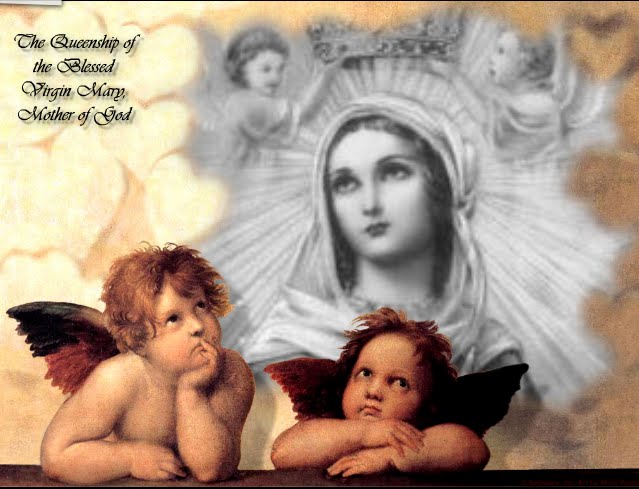
Thoughts on the Vigil of the Queenship of Mary

Mother Angelica remarked on an episode of "Mother Angelica Live" back in 1999, that Jesus's public ministry began with the Blessed Virgin Mother's "second fiat".   Our Lord, addressing his mother lovingly with, "woman", as an allusion to what was written in Genesis ("I will put enmities between thee and the woman, and thy seed and her seed: she shall crush thy head, and thou shalt lie in wait for her heel." Gen. 3:15) and what was to be written yet in Revelation ("And a great sign appeared in heaven: A woman clothed with the sun, and the moon under her feet, and on her head a crown of twelve stars... " Revelation 12:1) he asks her what was this to him since his time for public ministry had not yet come.  The Blessed Virgin Mother's response was prompt, knowing that her son was saying, "my ministry does not come until you give your second fiat."  She immediately then tells the servants, "Do whatever he tells you."  She KNEW that Jesus would make the wine from a miracle, but that he would require faithful servants, as she knew that her first fiat was required by God the Father to bring God the Son to take flesh.  The Blessed Mother knew that obedience to God is the condition God requires for in making "new wine" from old wine skins.  When we become of the age of reason, we then have the responsibility of chosing God's Will.  The Blessed Mother's first fiat was to the Holy Ghost, who espoused her after she gave her word that she would accept whatever was the holy Will of God.  God the Father chose Mary to bring about the physical manifestation of His love, that is Jesus Christ, through her espousal to the Holy Ghost.   This is the reason it is fitting to celebrate the QUEENSHIP OF THE BLESSED VIRGIN soon after the Solemnity of the Most Holy Trinity.    There is no greater queen than the one who is most intimately connected to the Most Holy Trinity, since she has power given to her by God by her submission to Him, and because He chose her out of all His creation for this role.

Majestic Queen of Heaven and Mistress of the Angels, thou didst receive from God the power and commission to crush to head of Satan:  wherefore we humbly beseech thee, send forth the legions of heaven, that, under thy command, they may seek out all evil spirits, engage them everywhere in battle, curb their insolence, and hurl them back into the pit of hell.  "Who is like unto God?" 

O good and tender Mother, thou shalt ever be our hope and the object of our love.

O Mother of God, send forth the holy Angels to defend me and drive far from me the cruel foe.

Holy Angels and Archangels, defend of and keep us. 

An indulgence of 500 days (S.C. Ind., July 8, 1908; S.P. Ap., March 28, 1935).
O Mary, my dear Mother and mighty Queen, take and receive my poor heart with all its freedom and desires, all its love andaffection, and all the virtues and graces with which it can be adorned.  All that I am, all that I might be, my Lady and Queen, all that I have and hold in the order of nature as well as of grace, I have received from God through thy loving intercession; into thy soverign hands I commit it all, that it may be returned to its noble original; wherefore we confess that thou art the channel whereby the graces of heaven decent upon us; thou art likewise the aqueduct which carries them back to their source; thou art, as it were, an electric wire, whereby we are put in direct communication with our heavenly Father; thou art the immaculate way which leads us safe to the Heart of God.  Take, then, and accept all that I am, O Mary, Queen of every heart, and bind me to thee with the bonds of love, that I may be thine for ever, and may be able to say in truth:  "I belong to Jesus through Mary."  Thee onlly will I love, my Mother most pure; lend me thy heart; give me love for thee and for Jesus, and it is enough to make me happy and blessed in live, in death and in eternity.  Amen.
An indulgence of 500 days.
A plenary indulgence once a month on the usual conditions for the daily recitation of this prayer
(S.P. Ap., July 29, 1924 and July 12, 1933).

Why I Started This Blog

Since it has come to my attention that quite a number of people from various parts of the globe have been venturing through this blog, I felt a responsibility to say a little more about it.

First of all, I am not a theologian.  I am a practicing Catholic who has the greatest fortune of being in a devout part of the world.  As a result, I have been exposed to many knowledgeable priests with a solid, orthodox understanding of the teachings of Roman Catholicism.  My understanding is rooted in the fact that what is truly "catholic" is true for all places, for all peoples, and for all times (this is not the belief of the modernists that predominate even most Catholic universities of this day).  I understand how and when the pope is infalliable, and do not subscribe to any heresy that the Chair of Peter is vacant.    Since I am exposed to many good priests, I have been pointed in the direction of many reliable resources for further study.   These resources are always rooted in an authentic understanding of the teachings of our Church's extrinisic and intrinsic patrimony, as supported by the Church Fathers and Doctors.

The first thing that prompted me to create this blog was my desire to maintain my HTML skills.  I thought it would be important that I not lose these skills, and I like to play with the code.  Secondly, I created this blog for myself, as a type of mini, online repository of some of my favorite Catholic things, ranging from music to doctrine.   Sometimes I will think of something I learned several years ago, and place it in the context of something I heard recently, and wish to write about it.  I do this so I can keep it in sort of a virtual scrapbook.  In this sense, I do this mostly for myself, however, since I realize that my friends, and even many more strangers are visiting here, I also try to include items that are useful to the audience, and never write beyond what I know already to be true.  (In other words, I do not give my personal opinion on matters of doctrine, but rather, share what is already taught and revealed by Holy Mother Church.) 

This is sort of like my virtual, Catholic scrapbook:  it is a miscellaneous conglomeration of some of my favorite things being stored away for posterity, firstly for myself, and secondly if anyone should happen to come across them.